Think about your last creative project, one you were really proud of. Now ask yourself: how much of what you contributed can you actually take credit for?
The aesthetic sensibilities that shaped it; absorbed from exposure to others’ work. The underpinned theories; borrowed from decades of research. The techniques and craft; learnt from teachers and mentors. Strip all that away, and what remains that’s completely of your own creation? Probably very little.
A collective genius
Many of us still have romantic notions of the creative genius; a tortured artists toiling away in private, drawing inspiration from some mystical source. What we observe less is the apprenticeship and absorption preceding any creative output; years spent soaking up influences, studying techniques, internalising practices that become indistinguishable from sensibility.
Much of my own creative sensibility emerged from two visual blogs I cultivated during the early years of my architecture studies. I spent hours scrolling, viewing, curating. The taste, style, and preference I now consider foundational to my creative practice weren’t lessons I consciously learnt; they were emergent properties of what I was exposed to. To this day, I still reference that library of ideas. They play a significant role in shaping how I think about design, about what I believe to be possible.
I think most creative professionals will be able to relate to this. It’s how we learn; through imitation, apprenticeship, years of studying before mastering. Much of what we achieve as a species is the result of learning about what came before to then shape something new.
Consider the phenomenon of multiple discovery, when two or more thinkers independently arrive at the same conclusions around the same time. Both Newton and Leibniz invented calculus independently and nearly simultaneously. Both Darwin and Wallace arrived at the theory of natural selection while working on different continents. Researchers have identified over 148 major scientific discoveries that fit this pattern.
German philosophers termed it the zeitgeist; the spirit of the times. Stuart Kauffman, a theoretical biologist and systems researcher, theorised it as being the “adjacent possible“; the space of opportunities that are just one step away from what currently exists. He posed that certain discoveries can only happen once the supporting knowledge has matured. When the knowledge ripens, multiple people reach for the same idea; because they’re exploring the same expanded territory of what’s become thinkable.
What you experience as individual breakthroughs are moments when you successfully rendered something emerging in the collective imagination. Your contribution is real, it’s just not as individualistic as it feels. You’re part of something greater; a broader creative sub-consciousness that extends far beyond your mind and is a product of your epoch and culture.
Blurring cognition
Our brains can juggle about seven items in working memory at any one time. We think sequentially because you cannot grasp all possibilities simultaneously. We sketch, write, and speak out loud because externalising ideas reduces cognitive load (something researchers call cognitive offloading). Every creative tool you’ve ever used is, at its core, an elaborate workaround for biological limitations you are bound by.
Andy Clark and David Chalmers, in their 1998 paper on the extended mind, asked: “Where does the mind stop and the rest of the world begin?” Their answer challenges what we typical consider to be cognition. They argue that if a process outside your head could be considered cognition if it occurred inside your head, then it is a part of your thinking; regardless of its external nature. This means written notes aren’t just memory aids; they’re part of how we think. A notebook isn’t supplementary to the creative process but constitutive of it.
This theory reframes our understanding of how we think. Language isn’t merely a communication technology; it enables abstract thought. Writing systems don’t just record ideas; they transform the kinds of ideas we can have. Every tool we integrate into our thinking process changes how our mind works.
But most tools – notebooks, sketchpads, even search engines -are passive. They extend our thinking, but they don’t progress it, at least not without our active participation. But what happens when our tools begins to generate ideas alongside us?
Large Language Models (LLMs) are enabling us to probe the collective plane of knowledge more widely than ever before. They don’t just retrieve; they interpret, reframe, and sometimes surprise. The interaction feels less like using a tool and more like conversing with a peer who’s drawing from the same cultural repository. When you work with an LLM, you’re not merely offloading tasks. You’re externalising your creative process to the equivalent of a thinking-peer.
“Bisociation” may be an important guiding principle for navigating this new frontier. Put forth by Arthur Koestler in his 1964 book The Act of Creation, bisociation is described as the act of connecting two previously unconnected frames of reference. The creative act isn’t the struggle of navigating our neural bottlenecks but uncovering connections that didn’t exist before.
From creation to curation
Artists have long understood the creative act as being the curation of connection. Many renaissance workshops operated as collaborative enterprises where teams would work together to create art. Raphael oversaw fifty assistants. Rubens sketched initial designs while training Van Dyck to paint backgrounds. The bottega, the atelier, the guild workshop; these were systems where apprentices contributed to works signed by their masters. Authorship resided in vision, not the labour.
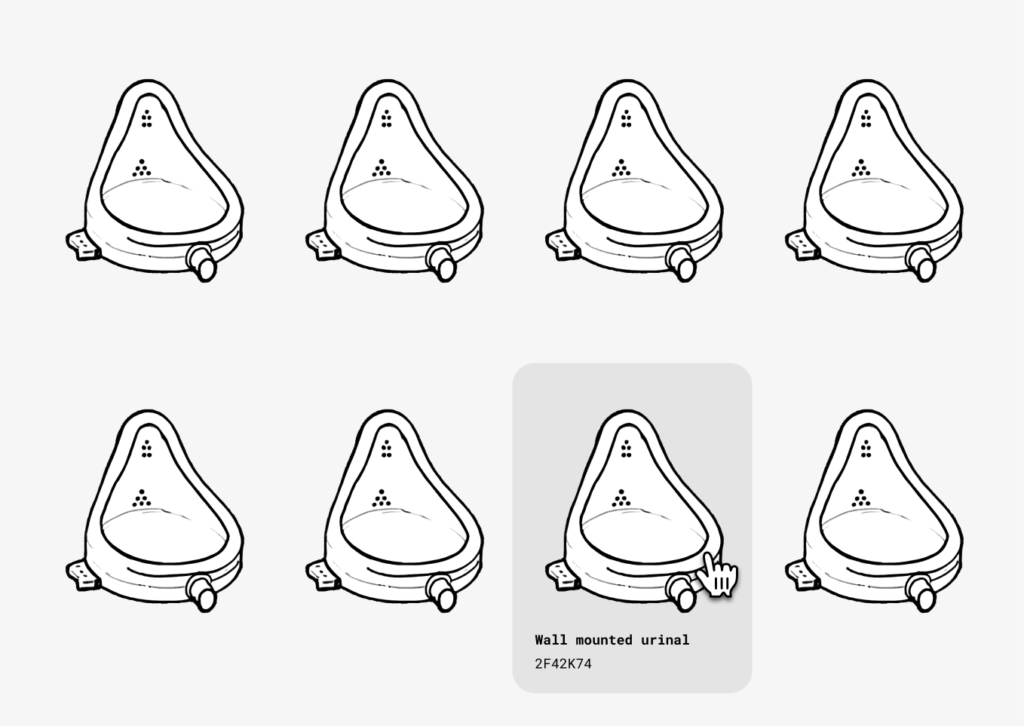
When Marcel Duchamp submitted a mass-produced urinal to the Society of Independent Artists exhibition in 1917, he extended this notion even further by removing creation from the equation altogether. He argued that it was the choice that mattered, proposing meaning-making as the irreducible creative contribution. Not the struggle to produce, but the judgment about what matters; the discernment of which connections were valuable; the recognition of when something is right.
Architecture and design studios operate on much the same principle. They establish schools of thought; ways of seeing and making that define what counts as good work. The studio’s value lies not in the production of any single work but in the institutional judgment that shapes every decision.
What LLM changes is the level at which this type of curatorial decision making can occur. The capacity to conceive, curate, and direct that was once the territory of well-resourced studios and masters now extends to individual practitioners.The creative act as orchestration; knowing what question to ask, recognising which output reveals a direction worth pursuing is becoming accessible to everyone.
When Koestler described bisociation, he emphasised that the creative act wasn’t just about connecting frames; it was also perceiving “reality at several planes at once”. That perceptual ability; the capacity to recognise significance, to judge what matters; is what has always defined human creativity and ingenuity.
For centuries, the power to scale that ability was only available to workshops and studios with the resources to employ skilled hands and minds. That’s now changing; every creative professional can direct at a scale once the exclusive domain of only a well-resourced few.
We are at a point where what we understand to be the creative process is shifting from individual acts to our distinctly human ability to make meaning and curate. The romantic notions of the solitary genius was always a myth; whats replacing it is an understanding that creativity emerges from our collective knowledge, extended through tools, shaped by the cultural moment we inhabit. What it means to be a creative practitioner is shifting form asking “can I make this?” to “is it worth making, and why?“